

If you’ve ever been on the receiving end of an objection, you know it’s uncomfortable. Objections come in different shapes and sizes, too. These can be internal objections and external objections. They can be related to your product or service, or your company’s ratings. They can even be related to the prospect you are pursuing. No matter the form, they are all a little uncomfortable, but they don’t have to be.
If you just want the tips, feel free to skip forward to those. But I do think it’s important to first outline the difference between an internal and external objection, because the outcome will ultimately depend on how you handle each unique situation.
First things first though: Let’s define an objection.

It’s important to note that I’m actually sort of lumping sales and marketing into a broader category when I talk about these objections. While they are different, for this post, we’re going to lump them together because, well, I’ve found that objections tend to parallel for the two.
Objection (noun) ob·jec·tion
Merriam-webster 6
1: an act of objecting
2a: a reason or argument presented in opposition.
b: a feeling or expression of disapproval.
c: a statement of opposition to an aspect of a judicial or other legal proceeding file an objection to a proposed bankruptcy plan.
Okay, I realize we aren’t exactly talking about legal proceedings. But depending on the type of objection you’re facing… I actually find it useful to relate the term to the judicial system.
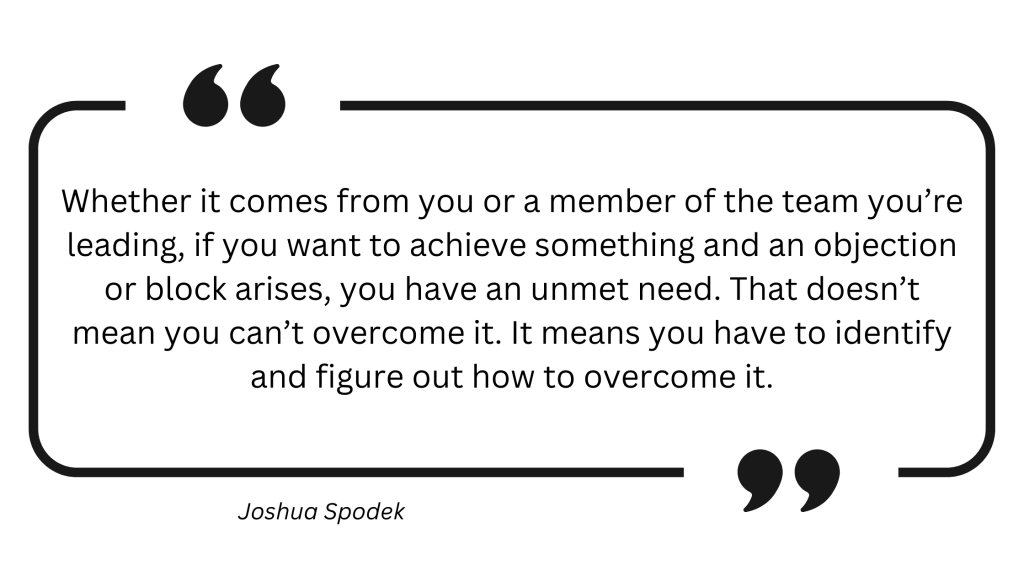
Years ago, I worked for a home health agency as a business development representative. Similar to my more current position, I had to not only appeal to the client themself, but also to the care coordinators and my own leadership. Care coordinators take a lot of heat from the Hospitalist to find discharge resources for their patients. It was my job to determine (and fast) whether or not we could accept their patient for home health services. The barrier I ran into more often than not might surprise you: Getting my leadership on board. Now this wasn’t for every patient, but some of these individuals had pretty unstable living environments. Therefore, it was my job to ‘state a case’ for each potential client.
While I trained two younger ladies for the same role, I actually told them to picture themselves as lawyers, so to speak. Instead of merely asking ‘can we accept this patient?’ – gather the information that you know will be questioned, have answers prepared, and tell them why this person is a good fit for our services. Not only does this save your own personal time and energy - it also saves every stakeholder involved their time and energy, too.
But to do this well, you have to have a good idea of what objections will be raised and why – just like a lawyer. The same goes for selling a product or service to the client themself. Although… it should go without saying that we never want to argue with a client – or even our team. But we do want to have our strategies ready to go.
Internal Objections
These are objections often raised by your team members or leadership. They can arise in both product and service sales situations. Internal objections are often raised for the following reasons:
- Lack of budget
- High cost
- Staffing constraints
- Staff training needs
External Objections
These, well, you guessed it… these are often objections raised by the prospect. These ones can also be a little trickier to identify. Some of the common types of external objections include the following:
- Disinterest
Sonia Joseph at Badger Mapping also refers to this type of objection as “the blowoff” – and explains that it is typically an impulsive response to a sales pitch. 2
- Irrelevance
This type of objection is raised when the prospect doesn’t see a need or use for the product or service.
- Uncomfortable with saying ‘no’
In senior living sales and marketing, we often call this the ‘slow walk to no.’ You may hear something like, “I’ll have to call my husband first and get back to you,” “I’ll think about it and get back to you,” or “Why don’t you send me some information and I’ll look it over with my wife.”
- Lack of urgency
This type of objection is raised when the prospect doesn’t see an immediate need for the product or service. I would argue that this comes from a place of complacency or comfort with a similar product or service.
- Cost
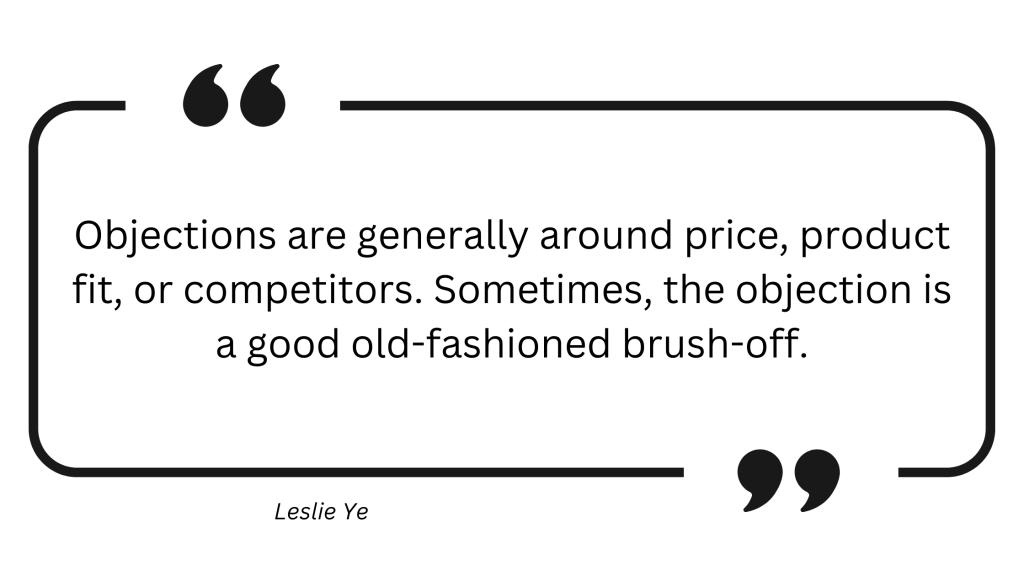
Leslie Ye at HubSpot says that objections based on price might be the most frequent type of objection that you come across, since all purchases come with some degree of financial risk. 13
- Brand awareness (or lack thereof)
Similar to a lack of urgency, this type of objection may also come from a place of complacency or comfort with a similar product or service. The difference here is that they’ve likely either:
a. Heard or read poor reviews about your product or company,
b. Are more familiar with a competitor, or,
c. Have never heard of your company or product.
- Distrust
According to Sonia Joseph at Badger Mapping, this type of objection often comes as a result of being bombarded with advertisements and sales pitches – thus, we “develop a natural resistance to any sort of sales pitch that comes our way.” 2 I refer to this as distrust. It’s completely natural to hear a sales pitch and think ‘you just want to meet your quota.’
Objection Handling
How do we magically turn a ‘no’ into a ‘yes’? Resolving objections requires two key elements. The first is that you need to understand it. The second is that you need to remember that it is not a rejection.
These go hand in hand with each other for multiple reasons. For one thing, if you take every objection personally, your confidence is likely to take a hit. And when you aren’t feeling confident, well, let’s be honest… you’re going to really struggle building any sort of trust or rapport with your prospects.
To understand the objection, I’m going to introduce (or re-introduce) you to IMPACT Selling, which is defined by 6 key steps in the sales cycle 11:
- Investigate
- Meet
- Probe
- Apply
- Convince
- Tie It Up
I’m going to take you right to the probe step. To understand the objection, you need to ask the right questions to identify the concern, and then you need to isolate that concern. 11
Before we get to probing questions, let’s talk about why you want to isolate the main concern. Take for example, a customer who is really unhappy with a hotel. Let’s say they bring their concern to the manager, who tells them they will ‘look into it.’ The customer thinks, ‘Okay, they heard me.’ But they don’t feel totally satisfied because now they have to wait and see if any action is taken.
Meanwhile, they go back to their hotel room and notice the housekeeper hasn’t replaced their towels yet. The next morning, they head down to the lobby only to find that they’re 5 minutes late to the complimentary breakfast and everything has already been put away.
Reasonably, the customer might not take either of these two instances as a fault of poor customer service on behalf of the hotel. But when we’re already upset, or on the verge of upset – these two instances add up in our brains. The next thing you know, you’ve received a poor Google review and a list of exacerbated reasons written to justify it.
A year later, hotel sales staff are under pressure for low occupancy and calling former guests to book another stay. This customer says to you, ‘I will never stay there again,’ and proceeds to list off each reason behind their decision. By identifying their concerns using the right probing techniques, you can then isolate the main concern in which everything else stems from. Because the reality is, if you spend all of your energy and time trying to resolve all of the little things, your client is likely to remain unhappy because you haven’t solved the real reason behind their objection. On the flip side, if you spend your time and energy on resolving the main concern, all of the little concerns are likely to fade out of their minds.
Feel, Felt, Found
To isolate the main concern, try to identify the underlying emotion that is tied to the objection. Is it anger? Fear? Guilt? Ignorance? Or maybe its skepticism. This is otherwise going to lead right into the Feel, Felt, Found method, which is a three-step process that involves “highlighting shared experiences between yourself and the potential customer (feel), talking through past experiences (felt), and capitalizing on customer feedback (found).” 3
The feel statement acknowledges and validates the prospects’ objections or concerns. 3 In other words, it demonstrates empathy. This way you are demonstrating your respect for their beliefs without punishing them for feeling how they feel. 8
Applying the feel statement correctly entails you to know which emotion is tied to their objection. You cannot appropriately respond to an objection that is based on fear unless you can place yourself into your prospect’s shoes.
The felt statement is where you relate to the prospects’ concern by referencing relevant past scenarios, such as other clients that had felt similarly at first. 3
Daniel Ku explains the importance of the felt statement in these situations because it demonstrates social proof of similar clients with similar apprehensions. 3 “It helps the prospect feel as though they are part of the majority.” 3
The found statement ties into the felt statement. This is where you would describe what was found through implementing the solution or product you are offering. 3 “This should give them a sense of relief and hope regarding resolving their underlying issue or problem.” 3
Andy Smith, Emotional Intelligence Coach with Coaching Leaders provides an excellent example of what the feel, felt, found method might look like:
“I understand you feel that there are cheaper competitors around. One of our biggest customers felt that way initially, but when they tried the service they found that they saved 55% on their cost base.” 10
Evaluating Your Methods
Another, very similar or overlapping method for handling objections using feel, felt, found is known as the I3CE-T Method: 11
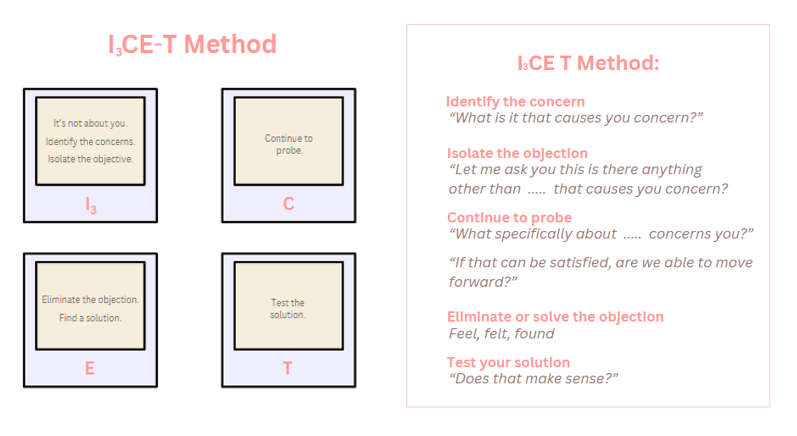
Using the I3CE-T Method, create a list of the 5 most common objections that you might hear from a prospect in your industry, and then write down questions that will allow you to focus on the appropriate solution. 11

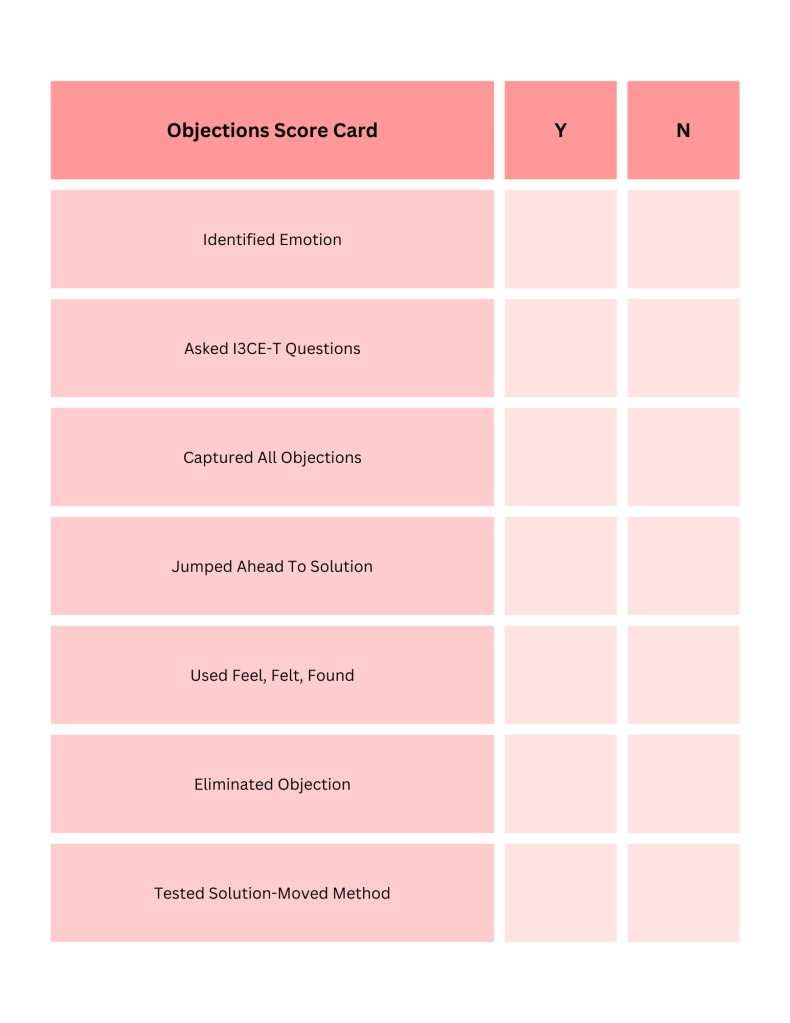
You might also consider using a scorecard (after the meeting) to identify any areas that you may have missed. 11 This can be particularly helpful in situations where the prospect, despite your efforts, remained skeptical.
How you handle an objection is going to vary based on the situation. Even so, this doesn’t negate the fact that each individual has their own reasoning behind their skepticism. You really have to know why they feel how they feel in order to offer a solution that will motivate them to re-examine or change their perspective. Asking the right probing questions can help you to identify your prospects’ concerns.
Probing Questions
- “Could you please give me some background to this?” 5
- “How would you describe the problem you’re trying to solve?” 9
- “What about this situation keeps you up at night?” 9
- “What goals and objectives do you have for this?” 5
- “What challenges have you encountered in the past while trying to solve this problem?” 9
- “Can you give me an example?” 5
- “How much is this problem costing you personally?” 9
- “How much is it costing the company?” 9
- “How does this look/sound/feel to you?” 5
- “Why isn’t this particular service/product/situation/issue working for you right now?” 5
- “What kind of timeframe are you working in to fix this?” 5
- “Is there anything else about the situation that worries or frustrates you?” 9
- “What other factors have we not discussed that are important to you?” 5
- “If you could design the perfect solution, what would it look like, how much would you spend, and how long would it go for?” 5
- “Have I covered everything?” 5
- “What are your top three requirements that this solution just has to have?” 5
- “If there is a current supplier, what are your reasons for considering an alternative?” 9
- “Is there anything I have overlooked?” 5
- “What else should I know?” 5
For a full list of probing questions, I recommend checking out HubSpot’s article 100 Sales Probing Questions to Truly Understand Your Prospects’ Pain.
Sales Statistics To Get You Thinking
You don’t have to be selling a product to analyze this statistic. The Feel, Felt, Found method can be used to demonstrate your product or service by showing your prospect how your company has helped other clients in similar situations.
Never overestimate your knowledge of the prospect. (I would know… I have made this mistake in the past and it bit me in the you-know-where, and fast.) Using the right probing questions, you will get enough information about your prospect in order to tailor your approach to their needs.
I added this one here because… you can be prepared for an array of objection types… but if you aren’t familiar with your social media or Google reviews, how can you address one of the most common objections: ‘Why is your rating what it is?’
I represent several nursing homes. My job is meet with prospects (usually in the hospital setting) and essentially, close the deal. We want to be their choice for post-acute care. I’ve worked to ensure that I am extremely familiar with our Medicare star ratings and ready at any moment to discuss any facility’s rating in particular. But in my first few months on the job, I failed to keep up with our Google reviews. So, when a prospects’ daughter asked me point blank: “Why have there been such poor ratings in the last few months about your facility?” Let’s just say, I didn’t win over that prospect. I learned from the situation though, and that night, I made sure to do my homework on our social media accounts.
Feel, felt, found people! I can’t say it enough. Make sure that your prospects feel comfortable. Keep it personalized. And please, please… remember that prospects are not number signs. (Yeah, I said it). If you’re in sales or marketing just for the money, you probably won’t convert a lot of clients. Or maybe you will, but they likely won’t be qualified prospects.
I once had a marketing counterpart who accepted every prospect that had traditional Medicare as their primary insurance payor. (For a nursing home, traditional Medicare is the number one best payor source.) However, that doesn’t mean that every client with traditional Medicare is appropriate or qualified for our services. We ended up with an exhausting number of unqualified patients, many of whom were had some truly acute (highly complex) medical needs that our staff weren’t equipped to care for. None of which was fair to the patients, or the staff, and certainly did us little justice in the end. That facility went from having a 4-Star Medicare rating to a 1-Star within a year.
Lead nurturing is engaging your prospects by offering relevant information. 4 “There are a number of ways to nurture leads including targeted content, multi-channel nurturing, multiple touches, timely follow-ups, and personalization.” 4 Feel, felt, found anyone?!
I don’t think I’ve mentioned this one yet, but it’s definitely worth emphasizing: It’s not about you. Practice replacing the words ‘I’ and ‘me’ with ‘we’ ‘our’ and ‘us’ in your sales pitch.
- “Asking questions about your buyer’s goals and pain points leads to better sales success [Gong].” 12
Probing is so important for understanding the prospects’ needs. “This allows the prospect to reveal information about their challenges in their own words. It also sets up the relationship on the right foot as the prospect feels heard.” 9
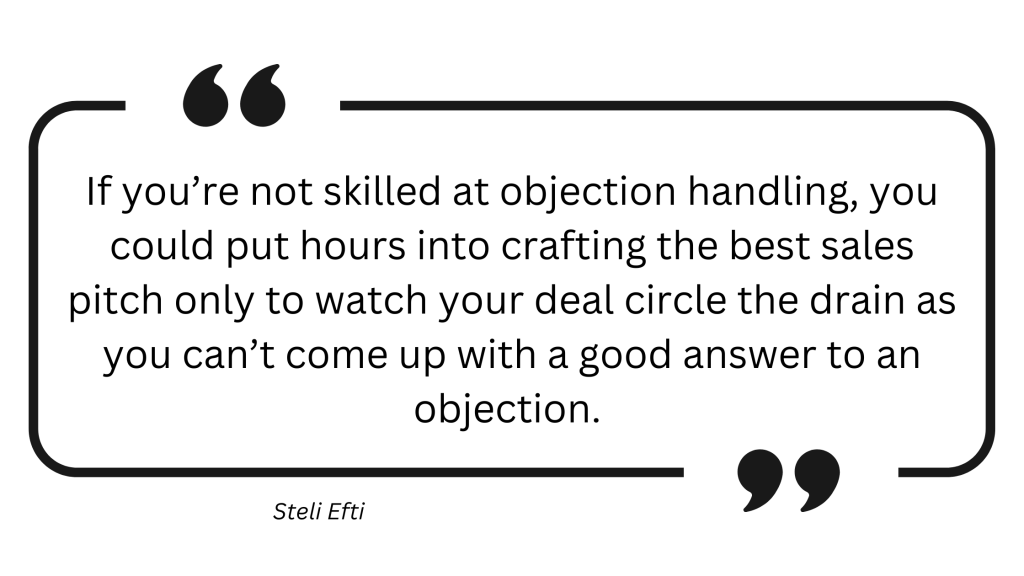
Successful objection handling entails meaningfully responding to your prospect without pushing them to buy. 1
References:
1 – Efti, S. (2024, February 17). Objection Handling: How to overcome sales objections and win more deals. The Close Sales Blog. https://blog.close.com/sales-objections/
2 – How to Overcome the 7 Most Common Sales Objections [with Response Scripts]. (2024, January 31). Badger Maps. https://www.badgermapping.com/blog/how-to-overcome-sales-objections/?utm_source=google&utm_medium=cpc&utm_campaign=performance%20max%20pro&utm_content=&keyword=&match_type=&gad_source=1&gbraid=0AAAAADrtUJH9e9GFDlZNtZSQhM6wcX87h&gclid=CjwKCAiA_aGuBhACEiwAly57Maav0R8pFgK6IeIW7s9hHBmacFuWaXR8jAJpIcvOntEknIcKPRwsvxoCbTQQAvD_BwE
3 – Ku, D. (2022, December 13). Feel, felt, found: proven method to handle every sales objection. Revenue Reveal. https://revenuereveal.co/feel-felt-found/
4 – Mawhinney, J. (2022, June 17). 7 Amazingly Effective Lead Nurturing Tactics. HubSpot. https://blog.hubspot.com/marketing/7-effective-lead-nurturing-tactics
5 – McPheat, S. (2022, January 26). 100 Sales Probing Questions to Truly Understand Your Prospects’ Pain. HubSpot. https://blog.hubspot.com/sales/sales-questions
6 – Objection. (2024). In Merriam-Webster Dictionary. https://www.merriam-webster.com/dictionary/objection
7 – Overcoming objections and blocks in leadership and personal development: The overarching principles. (2014, March 12). Joshua Spodek. https://joshuaspodek.com/overcoming-objections-blocks
8 – Rockley, K. (2023, December 25). The Feel Felt found Method – what you need to know. The 5% Institute. https://www.5percentinstitute.com/feel-felt-found-method/
9 – Rose, L. (2023, February 10). Sales probing questions to uncover buyer needs. Sales Training Company – Award Winning Sales Training Classes & Seminars. https://brooksgroup.com/sales-training-blog/sales-probing-questions-uncover-buyer-needs/
10 – Smith, A. (2020, November 24). ’Feel, Felt, Found’ : How it works and how to use it better. https://www.linkedin.com/pulse/feel-felt-found-how-works-use-better-andy-smith/
11 – The Brooks Group. (2024, January 30). Top professional training programs for sales teams. Sales Training Company – Award Winning Sales Training Classes & Seminars. https://brooksgroup.com/sales-training/impact-sales-team-training-program/
12 – Tsao, J. (2024, January 10). 149 Eye-Opening Sales Statistics to consider in 2024 (By Category). SPOTIO. https://spotio.com/blog/sales-statistics/
13 – Ye, L. (2022, December 7). Objection Handling: 44 Common Sales Objections & How to Respond. HubSpot. https://blog.hubspot.com/sales/handling-common-sales-objections
 Business Diaries