

What could you do differently?
It’s January, which means the new year is upon us all! And for that reason, I love this prompt. It’s time to reflect on the previous year.
2023
It was a rollercoaster of a year. Well, then again, aren’t they all?
Probably. But this past year was particularly unpredictable for me. Ironically enough, I came across this emotional pain chart. *Oh, reader… you’re learning something new about me: I’m an alternative medicine fanatic.
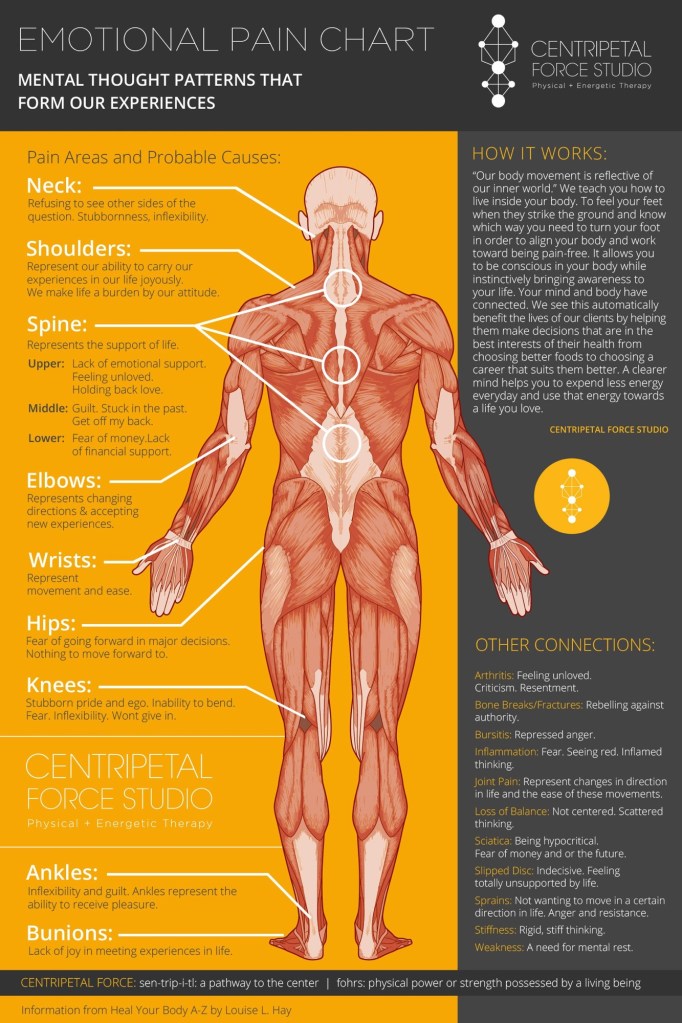
Most people I know seem to complain of back pain or headaches. Not that either is less significant! It’s just always piqued my curiosity that my pain points always seem to be my shoulders and neck.
For some reason, this chart hit home to me. I can take you back to my childhood (although we really don’t have time for that) – but I will say for the record I had a great childhood. Yet, even as a child, my neck and shoulders were always my pain points.
Now let’s fast forward to 2 years ago, when I got the results of my personality test back from my employer.
(I’ll write about personality assessments at a later date).
But yes, my company has prospective employees take a personality test prior to deciding whether or not to hire them. When I read my results, I was surprised to see that part of my ‘profile’ so-to-speak, describes my stubbornness. I was shocked… I had never thought of myself as being stubborn.
So, when I came across that emotional pain chart, I felt the need to really look in the mirror and see which areas of my life needed improvements. Where can I improve my mindfulness? I like think that reflecting on yourself at all, is a good step one.
So, what could I do differently?
I’ve spent a lot of time reflecting over myself in the past few weeks, if for no other reason than, well, it’s the new year. I’ve re-read my personality results and I’m excited to share them with you here.
As a business development manager, it’s likely not surprising that the personality assessment was tailored to sales behaviors. I took the Brooks Talent Index Level 3 personality assessment: Sales behaviors, motivators, and personal skills 2.
Starting with the Job Benchmark Comparison, here you can see my scores:

Digging a little deeper, let’s take a look at my personality profile (that’s what I call it).
“Molly becomes highly excited about what influences her. She usually displays this emotion when she is attempting to influence people. She prefers to sell a new client on herself first rather than her product or service. This reflects her natural approach. When she buys, she also prefers to be sold in this manner.” 2
And then diving even deeper into my sales traits…
“Some see her as a natural born salesperson but what they really see is her ability to talk smoothly and readily on most subjects. She quickly shares her opinion on most topics. If she gets into one of her “oversell” modes, she may cause the objections to be raised. However, she will welcome the objections and answer them to the best of her ability.”2
Okay… not so bad?
“Observers have actually seen her sell the product and then buy it back.”2
Ouch. I’ve seen me do this, too. (This assessment actually helped me recognize this before I do it, though!)
“In the Meet Step, Molly MAY have a TENDENCY to oversell herself to the buyer with excessive interpersonal engagement and frequent attempts at humor.”2
Okay maybe that’s enough sharing for now…
With all of that being said, each of us new-hires were then categorized based on our most prominent personality type.
The 4 personality styles, according to the Brooks Talent Index2:
Style 1: The doer

Doer types are direct and to the point. 3 “They tend to think in terms of the bottom line and often have a quicker, more impulsive decision-making style.” 3
General characteristics: 2
- Fast-paced speech
- Strong personality
- Impatient, makes decisions quickly
- Direct
- Tries to control the situation
- Buys new and unique products
- Loves change
- Drives fast and is always in a hurry
- Dresses formally to convey status
- Has many goals (usually high risk and not written down)
- Posture: forward leaning, hand in pocket
- Walk: fast and always going somewhere
Style 2: The talker

Talker types are friendly and talkative. 3 “They typically enjoy interacting with people and like chit chat … They tend to be less detail oriented, and focus more on the big picture.” 3
General characteristics: 2
- Friendly and talkative
- Impulsive
- Uses many hand gestures while speaking
- Shows much emotion
- Imprecise about use of time
- Buys trendy or showy products impulsively
- May not notice change
- Drives visually (looking around with the radio on)
- Dress is contemporary and stylish
- Not good at goal setting (good intentions but fails to plan)
- Posture: feet apart, both hands in pockets
- Walk: meandering, easily distracted to other destinations
Style 3: The pacer

Pacer types are patient and easy-going. 3 “They typically have a deliberate and methodical decision-making style, and can resist change or anything they perceive as a risk.” 3
General characteristics: 2
- Patient and easygoing
- Unemotional voice
- Reserved
- Deliberate and methodical
- Buys traditional products and is a slow decision maker
- Does not like change
- Drives at a relaxed pace, no hurry
- Dresses casually in comfortable old favorites
- Sets short-term, low risk goals
- Posture: leans back, hands in pockets
- Walk: steady, easy pace
Style 4: The controller

Controller types are methodical and deliberate. 3 ”They tend to focus on the details and are primarily concerned about doing things the “right” or “correct way.”” 3
General characteristics: 2
- Speaks slowly
- Asks many questions about facts and data
- Deliberates
- Uses few hand gestures
- Skeptical
- Suspicious
- Buys proven products
- Very slow decision maker
- Concerned about the effects of change
- Drives carefully, following rules
- Dresses meticulously
- Good at setting goals in many areas
- Posture: arms folded, one hand on chin
- Walk: in a straight line
I marched my way to the top left corner of the room, as the only ‘doer-type’ in our group. (haha) To be fair, I was a close call between a ‘doer’ and a ‘talker’.
So, why then, would I be one to show resistance to change? Well, here’s the thing. No one can be simply grouped into one personality type. We each carry many of the traits listed above.
My husband, for instance, is a pacer.
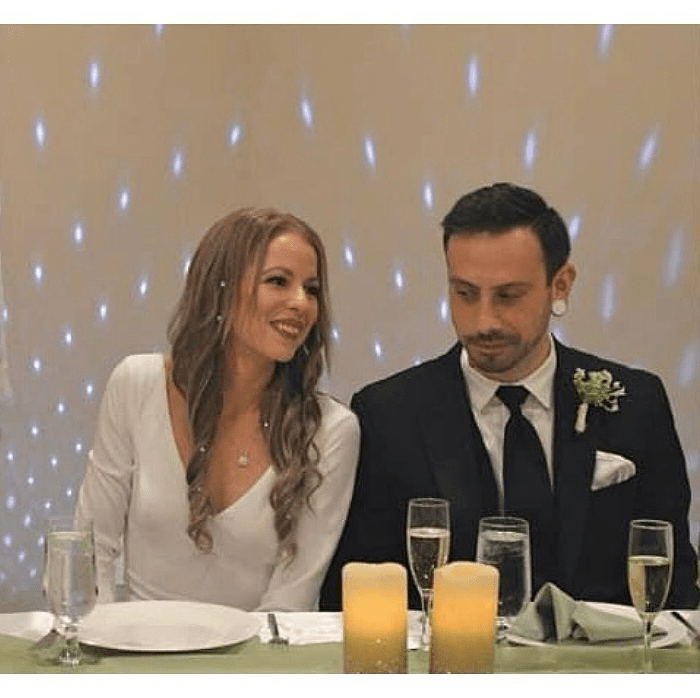
(I had him do the assessment)
It has taken me a long time to understand what my ‘profile’ meant when it said that I may show a tendency to resist change.
Unfortunately, this is my ‘doer’ side coming out. By that I mean… as much as I try, reader, I need to slow down and do a better job of truly focusing. I do believe this is both a blessing and a curse, however. I am fast, efficient and have a great track record for quickly identifying the important details of whatever it is I am reading or whoever I am listening to. But I’m not too proud to admit that I do need to slow down sometimes.
You see, it isn’t that I struggle with change… it’s that I have a tendency to struggle to change.
So, going back to the earlier emotional chart, neck pain may be a sign of an inability to see the other side of a question. Well reader, I’ve learned that I am stubborn. I see it even in my daughter. When we set our minds to things… well, we’re going to make them happen.
(For my daughter this means she’s going to build a make-shift mountain out of her stuffed animals so that she can reach whatever it is I put on top of the refrigerator, out of her reach.)
I admire her determination, I have to say. And *sigh* I did the exact same thing at her age. But for me, this typically shows up in the form of ‘No doesn’t exactly mean no, it just means I haven’t stated my case well enough.’
And let me specify what I mean by that. As a business development professional in healthcare, I not only work with clients and prospects…. I also work with diverse interdisciplinary teams. I always say, though:
I’m not a nurse and I won’t pretend to be one.
I leave the clinical decisions to the clinical experts. However, I’m also really good at spotting BS. And there are times when a little bit of negotiation with clinical leadership are all it takes to get their buy-in.
While I’m not one to ever bully anyone into a decision they aren’t comfortable with (that’s just untasteful, not to mention wrong), I do have a tendency to ‘stick to my guns’ and thus, persist. If a no is truly the final answer, I respectfully acknowledge the others’ ability to hear me out. But I also tend to carry that failure on my shoulders thereafter.
I can’t control anyone else’s decisions but my own. I know this. I have always known this, but I need to be more mindful of any toll it may take on me personally. That’s what I can control, and that’s what I can do differently this year.
Cheers to 2024
Happy New Years, readers.
If you are interested in viewing my results, I have nothing to hide:
References
1 – Centripetal Force Studio. (2022). Emotional Pain Chart. Cforcestudio.com. https://cforcestudio.com/resources/emotional-pain-chart
2 – The Brooks Group. (2023). Sales Training Company – Award Winning Sales Training Classes & Seminars. https://brooksgroup.com/assess/
3 – Rose, L. (2018, December 8). Identifying the 4 Buying Behavior Styles to Sell More Effectively. Sales Training Company – Award Winning Sales Training Classes & Seminars. https://brooksgroup.com/sales-training-blog/identifying-4-buying-behavior-styles-sell-more-effectively/
 Business Diaries