

Table of contents
1 | The importance of professional writing in the workplace
2 | Where this information can be useful
3 | Requesting a raise
4 | Creating an outline
5 | Email etiquette
6 | Cover letter formatting
7 | Stages of the writing process
8 | Final thoughts
The importance of professional writing in the workplace
If you’ve ever written a resume, an email to your coworker, or a letter of resignation to an employer, then you already have experience with professional writing. Professional writing is persuasive writing. 12
“Effective professional writing is clear, relevant, persuasive, and results-oriented to achieve specific business goals.”
Grammarly 7
It’s a valuable – and might I mention, transferable – skill for effective communication in the workplace. When done correctly, it can help you achieve your goals, influence others, and build trust and rapport. 2, 3, 4, 12, 15

I feel it needs to be mentioned, however, persuasive writing is NOT argumentative. While argumentative writing can intertwine with persuasive writing, they are two different things.
I think we need to focus on the persuasive aspect, so that’s what we’re going to do!
When would I need to use this information?
I know. Why should you care? Believe it or not, you probably write professionally more than you realize.
Here are some common examples of when/where you might write professionally 9:
1. Business letters.
Understand me please, reader. I’m well-aware that you may not be at the point in your career where you’re writing business proposals. (Or maybe you are). I want you to know that a business letter can take several different forms.
- Business proposal letters
- Letters of recommendation
- Interview follow-up letters
- Offer letters
- Letters of resignation
2. Emails.
Even if your job doesn’t require you to write emails on a regular basis, you still have likely written a professional email to someone. And if you haven’t yet, well… you will. Let me tell you, this is my favorite one to discuss. I’ve landed myself in… *ahem* quite the “prickly situation” because an email I’d sent was misinterpreted. I want you to learn from my mistakes, (we’ll get to those later).
3. Memos.
Companies use memos all the time to communicate important information to a large amount of people at once. Again, you may not be here yet in your job, or maybe you are. Whatever the case, you should want to know how to effectively reach a large and diverse audience. It’s going to save you precious time.
4. Meeting agendas.
This is extremely valuable, and like memos, an effective meeting agenda is going to save you precious time. It basically is an outline for your meeting, which usually highlights the topics/activities that are going to be discussed or need to be discussed.
5. Sales meetings.
To be fair, you don’t have to request a sales meeting via email. But many do. In order to land the meeting, you’re going to have to first capture the attention of the recipient. And then to make it more complicated, once you have their attention, you immediately need to begin the process of building a rapport (if you haven’t already).
I have the following quote on a sticky note above my desk. It’s from Shark Tank (arguably one of my favorite shows). I believe it was Kevin O’Leary (AKA Mr. Wonderful) that said these dear words that ring in my head every time I’m on a sales call:
“It’s not my responsibility to listen, it’s your responsibility to make me hear.”
Requesting a raise
The goal of persuasive writing is to persuade the audience. 13 And since we’re talking about professional writing as a form of persuasive writing, we need to try and treat it as such.
One of the key features of persuasive writing is that it “often uses emotional appeals to connect with the audience.” 13
In other words, your writing is going to use emotive language, anecdotes, or rhetorical questions to help guide your reader to a certain conclusion. 13

Okay… we’re not trying to make your boss cry! But maybe we’re trying to explain to them why you deserve a raise. Let’s talk about that one in a little more detail.
So, let’s say you’ve been at your job for 2.5 years. You’re a hard worker. You’re super reliable, you’ve learned your job in-and-out… you’re pretty much the glue that holds the place together. There’s just one tiny hang-up…
You make the same amount of money as you did when you first started.
You don’t want to rock the boat because you’re super grateful for your position. You’re desperate not to interfere with the status you’ve worked so hard for.
Alright, let me help you. When you’re ready to request a raise, there are a few things you need to keep in mind first. For instance, when you’re ready to request a raise, you need to make sure the timing is right. I understand perfectly, this may not be what you want to read. But believe me, timing is everything.
What I mean by this is… (whether you want to or not), you need to consider the financial health of your company. Are they doing mass layoffs? Because if so, this may not be the right time to ask for more money. But additionally, you need to consider other important things such as salary trends for your title. Are you already on the higher end of the scale? Because if so, then maybe a raise isn’t the right avenue to explore. Maybe you need to consider instead requesting some sort of promotion.
Let’s say you’ve followed the above advice. You’re pretty well-certain that a raise is what you’re looking for.
- Set a meeting.
- Especially if this conversation makes you slightly uncomfortable, schedule a meeting with your boss to discuss your compensation. This will give you an opportunity to present your case and discuss your salary in a private setting. 6
- Prepare.
- Again, if you’re uncomfortable with this conversation, prepare ahead of time. It’s only the oldest confidence-yielding trick in the book. Before you meet with your boss, prepare what you want to say. Which is precisely where this post may come in handy for you. You definitely need to be able to articulate why you deserve this raise, as well as and how much you’re asking for.
- Be ready to answer questions.
- Kind of goes hand-in-hand with preparation, but it’s worth repeating. Your boss is GOING to ask you questions regarding your request. Be prepared to answer them and provide evidence to support your case.
Creating an outline
Let me be a little bit blunt here: If you can’t relay your goals, needs, or requests effectively, then you are unlikely to achieve your desired outcome.
That was harsh, and I’m sorry for that. But you need-not take it personally. Here’s where your ability to write professionally comes in handy.
According to Elyssa Tardiff and Allen Brizee from Touro University, “It’s helpful to create an outline when you want to show the hierarchical relationship or logical ordering of information.” 14
An outline helps you keep track of large amounts of information. 14
“Many people find that organizing an oral report or presentation in outline form helps them speak more effectively in front of a crowd.”
Elyssa Tardiff and Allen Brizee 14
Having an outline with you also allows you to reference important information that is going to help state your case. For instance, you should have the following information ready to go:
- Your qualifications. Consider your education, years of experience, company seniority and any specialized skills or attributes you bring to the table. 9
- Your accomplishments. Have numbers ready, because when you’re talking about a salary increase, you’re talking numbers. Therefore, you’ll want to be able to show how your numbers align with the salary increase that you’re requesting. Consider sales percentage increases that you can showcase, or customer acquisition rates.
- An ideal salary range. According to Indeed’s Jaime Birt, 3% is considered an average or even generous pay increase. 9 My advice is to research salary trends for your position or title. You can find more information about job salaries on PayScale, Indeed, The Balance, JobSearcher, and Zippia.
If you need a place to start, templates are great. You can do a Google search for templates or make your own to keep on hand.
Let’s talk about email etiquette

“Maintaining good email etiquette is important because it communicates respect for the people you email.”
Lindsay Kramer 10
You will become a much better communicator by learning how to use communication tools, such as email. And reader, there is an art to crafting a professional email.
There are 5 important elements to a professional email:
(1) Subject (2) Salutation (3) Body (4) Closing (5) Signature
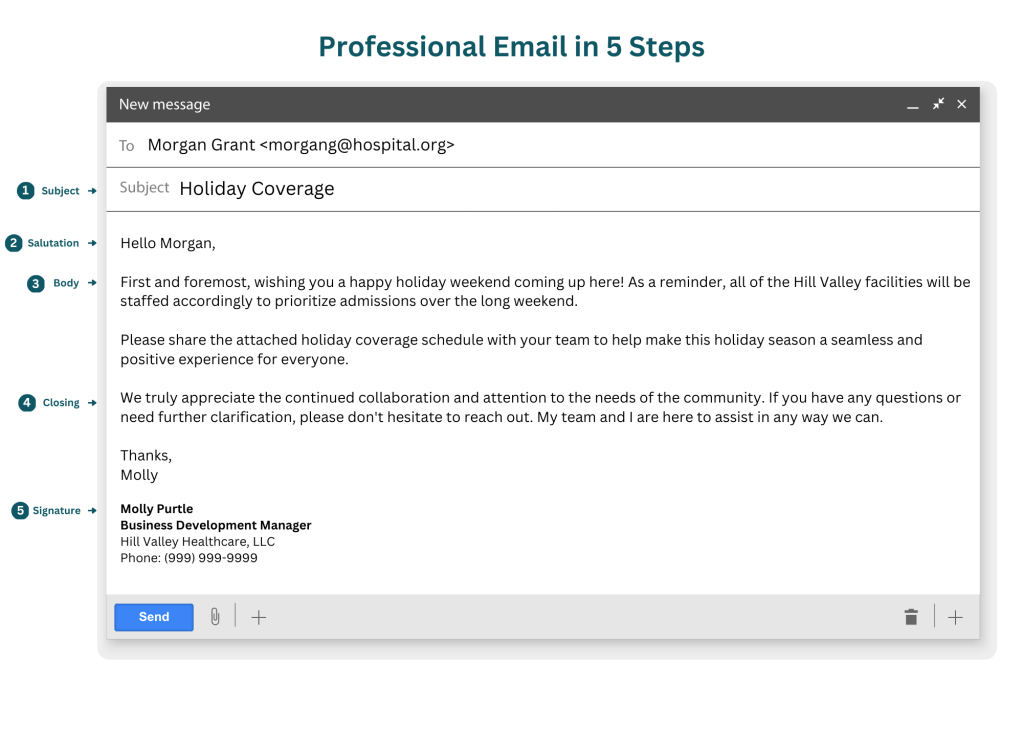
(1) Subject. A strong subject line encourages recipients to open the email. People are so busy all the time, they want to know from the get-go what they’re committing their attention to by opening your email.
When choosing a subject line, you should either:
- Keep it short, sweet, and vague.
- Keep it short, sweet and specific.
My own personal rule of thumb is: If you work with them, make it short and specific. If you’re trying to set up a meeting, make it short and slightly vague.
(2) Salutation. Every email should start with an appropriate greeting. 10 Examples of appropriate email greetings include these: Good morning [recipient’s name], Hi [recipient’s name], Good afternoon [recipient’s name].
With that said, depending on who you’re emailing, you may need to introduce yourself and/or remind them of how you received their contact information. A proper email introduction/salutation should include your first and last name, as well as the company you represent.
Example: “My name is Lilia Turner and I’m with Hill Valley Healthcare. Tom Johnson gave me your name and suggested I contact you regarding your [services].”
(3) Body. Keep it concise. By that I mean… don’t waste the recipient’s time with extraneous details or pack multiple conversations into one email. 10 As another general rule of thumb… use humor sparingly. I think there are many posts that will advise against humor altogether, but I disagree. Humor shows you’re a real human, I think. But that said… use it SPARINGLY and CAREFULLY. You need to think carefully about your word choices and how others may interpret your intention.
(4) Closing. Where your email starts with an appropriate greeting, it also should end with an appropriate closing sentiment. I highly suggest you consider using a semi-professional closing remark, such as the one in the above graphic. Additionally, include a professional closing sentiment.
Examples include:
- Regards
- Best
- Sincerely
- Thanks
- Cheers
(5) Signature. Your signature should include your name, job title, company website, phone number, and in some cases, your company logo.
Is it appropriate to negotiate my salary via email?
According to PayScale’s Jeff Zhong, “Negotiating in person gives you the opportunity to adjust your script, based on the feedback you’re receiving from the hiring manager – not to mention, his or her body language, which can be a big tip-off.” 16
While some experts may tell you that the only appropriate way to negotiate a salary is in-person, I only slightly disagree.
(Note: This does not mean I am opposed to this conversation being held in-person. I just think there are some steps that you need to take first to get there).
Let’s be honest, talking money can be uncomfortable. Not just for you, but also for your boss. My advice is to give your boss a heads-up first, and email is an appropriate way to do this.
Do I think you should negotiate over email? I don’t know, I think that depends on a multitude of different factors. But the bottom line is, it’s not only appropriate, but also courteous, to communicate what your intentions are by first requesting to schedule a meeting with your boss in which you can discuss your pay.
Cover letter formatting
A cover letter is a one-page document that accompanies your resume when you apply for jobs. 8 If you read my other post on resume do’s and dont’s, then it won’t surprise you when I say that each cover letter should be tailored to the job you’re applying for.
According to Grammarly, your cover letter should have one-inch margins on all sides, size 10–12 font, and 1.15 line spacing. 11
Below is a general example you can reference when crafting your cover letter:
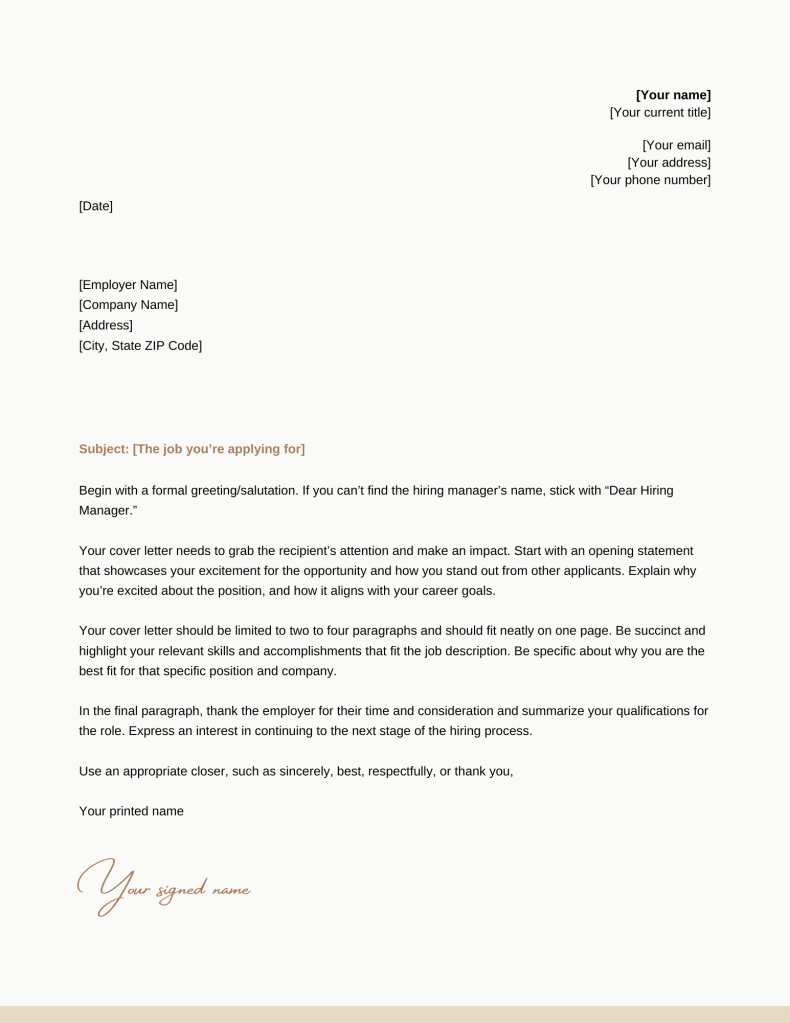
Some other considerations to keep in mind when writing your cover letter are the font. According to Indeed’s Jennifer Herrity, the font should be a basic one such as Arial, Calibri, or Verdana. 8 Now, you do want the employer to read your cover letter, and by that, I mean… don’t make it too simple:
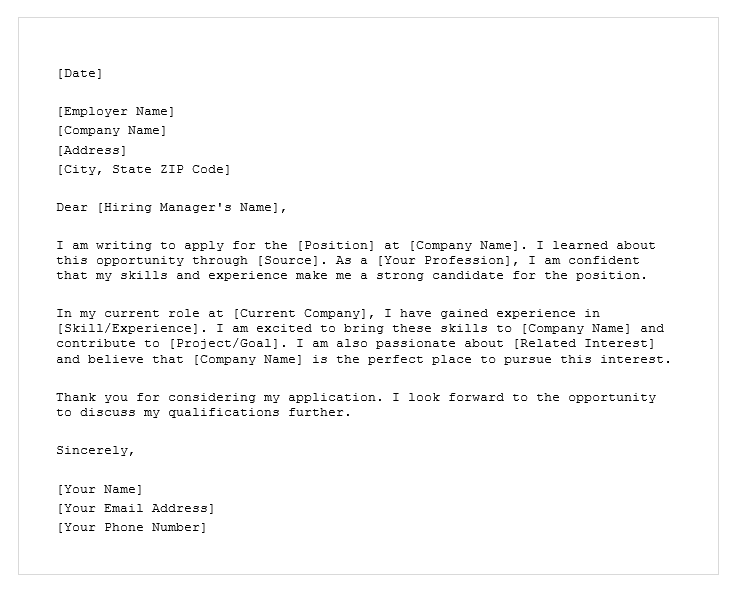
Eeek. I don’t know about you, but that was a little… hard on the eyes. You can and should give it a little bit of life. However, be careful when using color. Again, you’re trying to display your professionalism. While you shouldn’t get too fancy with colors or fonts, consider a small ‘pop’ just to help it stand out. But by small… reader, I mean small.
(Sorry, no hot pink).
Stages of the writing process

//Michelangelo’s Sistine Chapel
“Just as it might take multiple layers of paint and many tries to get a picture-perfect painting, so too will it likely take multiple drafts before your ideas are ready.”
Sophia 13
The professional writing process can be summarized in 3 stages:
- Prewriting
- Draft revision/Rewriting
- Proofreading
Let’s go through each one in a little more detail.
In the prewriting stage, you’re generating an overall plan or idea of what you’re trying to relay to your reader. 13 In other words, this is where you organize your thoughts. Especially when we’re talking about workplace writing, this stage is more important than you may realize. For instance, you likely wouldn’t just email an important client without first thinking about what you’re going to say, right? Just as well, you wouldn’t put together a cover letter without first thinking about what you want the employer to know about you. You may consider this stage a sort of ‘research’ stage.
The draft revision stage is more of an ongoing process, in that as you begin writing, you are constantly editing to ensure that your point is coming across as clear and concise as possible. (Reader, I am doing this as we speak).
In your final stage, you’ve ideally proofread what you’ve written. This is by far the most important step, by the way. Learn from my mistakes. Always, always, always proofread your writing before you click ‘send.’ Even if it’s just a simple email reply. ALWAYS PROOFREAD.
Final thoughts
Most of your professional writing will have you in a constant mode of fine-tuning. Ultimately, however, this is going to help you either develop, or enhance your ability to communicate effectively.
I hope you find that by acknowledging the importance of professional writing, new doors will open that will allow you to work towards your goals – and maybe even build your career or empire.
On a final note, I want to emphasize that by paying attention to or working on your professional writing skills, you’ll demonstrate courtesy toward your audience. Courtesy is a crucial skill for any professional. It’s going to help you connect better with your coworkers and clients and increase your level of confidence since you’ll know how to handle complex social situations. 5 But more than anything, a courteous professional is a respectful professional.
References
1 – Birt, J. (2023, June 29). How To Ask for a Raise: A Guide (With Tips and Scripts). Indeed. https://www.indeed.com/career-advice/pay-salary/guide-how-to-ask-for-a-raise
2 – Birchard, B. (2021, August). The Science of Strong Business Writing. Harvard Business Review. https://hbr.org/2021/07/the-science-of-strong-business-writing
3 – Birt, J. (2023, March 10). 13 Effective Ways To Persuade Others in the Workplace. Indeed. https://www.indeed.com/career-advice/career-development/how-to-persuade-people
4 – Bojic, A. (2022, February 2). How to Make Persuasive Communication Effective. Pumble. https://pumble.com/blog/persuasive-communication/
5 – Bolling, S. (2020). Why Is Courtesy Important? Classroom; Leaf Group Media. https://classroom.synonym.com/courtesy-important-21035.html
6 – Doyle, A. (2022, September 22). How To Write a Letter Requesting a Pay Raise. The Balance. https://www.thebalancemoney.com/sample-letter-requesting-a-pay-raise-2062777
7 – Grammarly Inc. (2021, June 14). What Is Effective Professional Writing and How Can It Improve Team Productivity? Grammarly. https://www.grammarly.com/business/learn/effective-professional-writing/
8 – Herrity, J. (2023, June 30). How To Format a Cover Letter (With Outline and Examples). Indeed. https://www.indeed.com/career-advice/resumes-cover-letters/how-to-format-a-cover-letter-example
9 – Indeed Editorial Team. (2023, June 22). 8 Examples of Business Writing. Indeed. https://www.indeed.com/career-advice/career-development/examples-of-business-writing
10 – Kramer, L. (2023, July 20). 19 Email Etiquette Rules to Know. Grammarly. https://www.grammarly.com/blog/email-etiquette-rules-to-know/
11 – Meltzer, R. (2023, July 5). 6 Tips for Formatting a Cover Letter. Grammarly. https://www.grammarly.com/blog/cover-letter-format/
12 – Purdue OWL. (2023). Workplace Writers. Purdue University. https://owl.purdue.edu/owl/subject_specific_writing/professional_technical_writing/workplace_writers.html
13 – Sophia. (2023). What is Persuasion? Sophia Learning. file:///C:/Users/mnpur/Downloads/what-is-persuasion.pdf
14 – Tardiff, E., & Brizee, A. (2023). How and Why to Create a Useful Outline. Touro University. https://www.touro.edu/departments/writing-center/tutorials/how-and-why-to-create-an-outline/#:~:text=Why%20create%20an%20outline%3F%201%20Aids%20in%20the,of%20your%20writing%206%20Defines%20boundaries%20and%20groups
15 – The Upwork Team. (2022, April 8). How to Develop Persuasive Writing Skills. Upwork. https://www.upwork.com/resources/persuasive-writing
16 – Zhong, J. (2017, January 16). Should You Ever Negotiate Salary Over Email? PayScale. https://www.payscale.com/salary-negotiation-guide/should-you-ever-negotiate-salary-over-email/
 Business Diaries