
As someone who touts themselves for thriving off of spontaneity; I am so routine.
My job is one of those that you don’t really ever ‘catch up’, but I like to pretend that there’s an opportunity each morning. I start my computer around 5AM to get an early start on anything data entry-related, since I know I won’t be next to my computer for most of the day.
I’m a hospital liaison, and I rely heavily on my iPhone during the day to receive and vet incoming patient referrals. Basically, anything that I can do with my work computer, I can also do with my work phone – minus saving or sending patient documents. Post-Acute discharge planning is busy busy busy. My phone dings! all day long. All day.
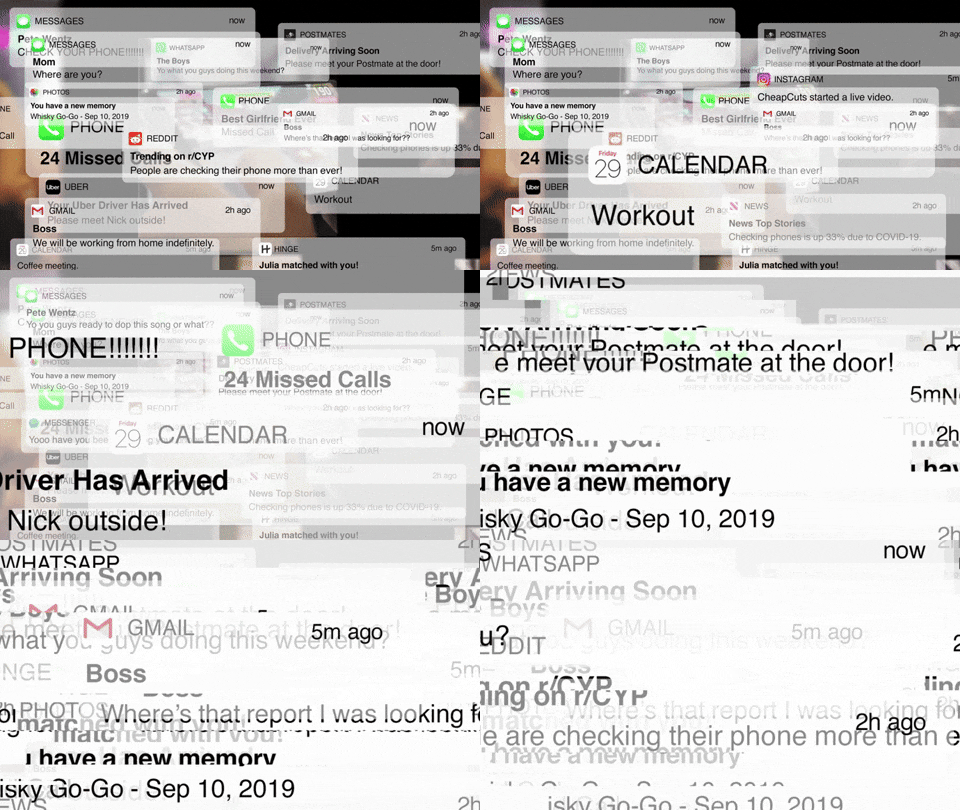
By 8AM – sometimes earlier, phone calls start. Have you ever seen Freaky Friday with Lindsay Lohan? The scene where Anna [trapped in Tess’s body] is walking out of the mall and her phone starts going off and she’s desperately trying to figure out which phone?! That’s how I feel some days.
My work phone is encrypted, which allows me to quickly view new referrals on the go via the nHIntake application. Our company’s email system and Customer relationship management (CRM) system is also readily available through the Boxer app, so I can quickly input referrals for easier tracking. [With completed consent forms, of course], I can take a quick photo of company events, activities, or patients for recovery success stories, and send them to our Social Media Marketing Specialist via the WhatsApp. This is the beauty of digital media. It has the ability to make life easier. I use these apps constantly throughout my workday.
There’s also a darker side to digital media.
Like most people, I scroll through Facebook, LinkedIn, and Instagram whenever I want a break. On the weekends, I love to scroll through Pinterest to find ideas for fun mommy-and-me activities to do with my toddler. (Or of course, DIY projects).
Last weekend, I posted a photo of myself next to my husband and daughter during lunch at the arcade. I loved the picture because everyone was looking at the camera and smiling (I can almost never get my daughter to smile for the camera). I loved the photo, so I wanted to share it. I think that’s the way most of us choose which pictures to share on our social media accounts, right?
Let me provide a little timeline of the following 6 hours:
~3:30PM Shared photo to Facebook
~3:40 Looked to see if anyone liked said photo (I think there were 2 likes)
~4:00 Looked to see if any new likes on said photo (I think we were at around 10 – 1 came in while I was looking)
~4:20-4:30 Looked to see if any new likes on said photo (they kind of stabilized around 10-15)
***FORCED MYSELF TO STOP LOOKING***
~7:30 Looked to see if any new likes on said photo (in the few hours I left it alone, we were up to around 30-35 likes)
~9:00 Final look to see if any new likes on said photo (we were at around 40 which I figured was likely going to be the peak)
Okay, I know I’m not the only one who does this. The weird thing is, I shared the photo because I liked it. So, it really shouldn’t matter if anyone else likes it. But it’s almost like I forgot how much I loved our family photo and became more interested in its popularity, (albeit short-lived popularity).
For this reason, I want to reference a 2018 article which examined the science behind our social media ‘Likes’ (Social Cognitive and Affective Neuroscience).
“While Likes are often provided as an indicator of social support, affiliation or acknowledgement of shared experience, they are frequently used to indicate approval or enjoyment.”
Lauren E Sherman, Leanna M Hernandez, Patricia M Greenfield, Mirella Dapretto, What the brain ‘Likes’: neural correlates of providing feedback on social media, Social Cognitive and Affective Neuroscience, Volume 13, Issue 7, July 2018, Pages 699–707, https://doi.org/10.1093/scan/nsy051
In a lot of ways, Likes could be interpreted exactly as they sound: Likes. The more Likes you have, the more you are liked. Have you ever deleted a photo off of social media hours later? Maybe it didn’t generate a lot of Likes? You know the saying: “Felt cute, might delete later!”
The point is, there is some science behind the feeling of inadequacy when I scroll through most of my social media accounts.
Noone liked my post. Wow, look how nice her house is. They’re always going on vacation; I want that life.
There is a leverage though that comes with the way we as humans perceive Likes.
One of the other interesting findings of this study was the effect Likes have on our classification of the user or account who shared the post. “When young people viewed Instagram photos with many Likes, compared with few, they showed greater responses in brain regions associated with reward and visual attention, and were themselves more likely to click Like,” (Sherman, et al. 2018). Social media marketers leverage this by posting visually pleasing images with the perfect catchline using attractive fonts to influence viewers. In other words, people care about Likes.
The social media platform I’m browsing seems to largely determine my satisfaction with its use. For example, I will advocate all day long for Pinterest, because who doesn’t enjoy unique healthy recipes and life hacks? Facebook on the other hand, generally falls into this category of an ‘unnecessary-but-necessary evil.’ I don’t think I’m alone in that either, I think most of us utilize Facebook to judge profiles of potential job candidates, new coworkers, and businesses. The number of Likes there are, (whether that be for a company’s profile or an individual’s post), can be very telling.
People still use email?
I once worked as a marketer for a psychiatric hospital. One of the tasks I was handed was to send daily morning emails highlighting our availability to hospital discharge planners and private practice psychiatrists and counselors. I was originally provided the ‘master copy’ (so to speak) of what these emails should look like and how they should be formatted. I was mortified.
You want to make sure to put in ALL CAPS THE BREAKDOWN OF AVAILABILE MALE/FEMALE/PSYCH/DETOX ROOMS. Make sure to highlight the insurances we’re contracted with. Let them know availability fluctuates so call ASAP. PUT THE SUBJECT IN ALL CAPS TOO SO THEY’LL SEE IT.
Oh yeah, and make sure to send to each individual instead of a mass email- otherwise they’ll think its spam.
I will be honest and say I didn’t comply, at least not like that. Okay, as a new employee, I definitely tried at first to do it their way. Unsurprisingly, I immediately started getting return emails saying, “Please take me off your list.” I mean… would you open an email like that? I wouldn’t.
First of all, yes, people still very much use emails to communicate. But there is an art to crafting professional emails, and it’s not that. When I get emails from other companies, I generally have a good idea of who the sender is. The subject line is usually personal to some degree, like “It was great connecting with you yesterday” or “Hoping to connect with you next week”.
From a consumer perspective, however, I tend to get more spammy emails.
(I blame myself though. Those “25% off for subscribing” links always get me).
It’s probably easier to say which emails I don’t open versus those that I do. My rules are simple. Basically, anything that’s super impersonal, like, “Shop quality vision plans today!” And anything that’s super personal from an unrecognized address, like, “is everything ok?? i’m trying to reach you molly” (Yes, that is an actual subject line from some spammy email). Lastly, anything from an email address that doesn’t fit any known language, I avoid:
b39oXe5pyJqsjFNdgIBFZ@gertecsao.onmicrosoft.com
Emailing is a great way to re-connect with people, or to set up new connections. I told you that I couldn’t consciously send those spammy emails detailing our bed availability. I ended up creating distribution chains because let’s be honest, sending 300 individual emails every morning to hospital staff across Washington is unproductive. My subject line was not in all caps, and simply stated something to the effect of:
“[company]’s bed availability for 8/28/22”.
My emails were in standard 11-point Calibri font and were short and to the point. I included a brief list of contracted insurance companies near the bottom, along with contact information. Most importantly, I made sure to include an opt-out option: “Please let me know if you would like to be removed from this distribution list.” My emails were (first of all) easier to send, because I could send to the created distribution group, versus each individual. Sending emails to multiple people at a time is not always appropriate, but in my case, I felt it was. Realistically, the hospital discharge planners are sitting next to each other. What difference does it make if Karen receives her email before Trisha? A distribution group split up by hospital is appropriate in this case.
My emails were also easier on the eyes. Less of the bold, highlighted, and 36-point fonts. Less exclamation points. They were short and they clearly stated their purpose. I received much better community feedback. Most of all though, people actually started responding with real questions, which means people were actually reading them rather than just auto-archiving them.
Digital marketing in 2022
Marketing in today’s world has to be subtle. LinkedIn is the perfect social media platform to watch this in motion, too. You will see marketers commenting on their competitor’s post’s congratulating them or saying something like “I hope you’re doing well! I heard about your new [company offering], let’s get lunch!” You will also see many marketers sharing current or aspiring business partners’ content in support of them. Marketers are so nice.
When it comes to digital media advertisements, marketers today are pretty well-versed in what people will or will not read. They know that a 15-second video clip is more likely to be viewed versus a full 3.5-minute video, because consumers want fast and get to the point kind of ads. Therefore, those 15-seconds have to be eye-catching. The cover image has to be visually pleasing. The subject or tagline has to be succinct.
Marketers also know that the digital content has to be relevant to both the company and the target market. If we don’t know who our readers or viewers are, how can we possibly address their pain-points? I am coming from a service-industry specific viewpoint, but the same generally applies to other industries like those that sell physical products. Most of the digital marketing is tailored to the company’s target market in the form of knowledge. In other words, digital marketing today typically draws on the company’s expertise to subtly reach their target by using industry knowledge combined with related facts or statistics to present their brand to the public as insightful and experienced.
Because marketers know that people don’t want to be marketed to; people prefer substance.
 Business Diaries