

Marketing campaigns
A marketing campaign is a series of strategic activities designed to promote products or services through different mediums. Often, marketing campaigns are intended to increase sales. However, they can also be constructed as a means of promoting a brand as a whole. They are well organized and tactically planned out in order to achieve the most effective results.
When creating a marketing campaign, it is important to focus on the actions that the organization will make in order to increase sales. You want the strategy to be productive, after all. One of the best ways to ensure a successful marketing campaign is to set SMART goals.

SMART goals
SMART is an acronym for Specific, Measurable, Attainable, Relevant, and Time-related.
SMART goals allow you to clarify your ideas and ensure you are making productive use of time and resources.
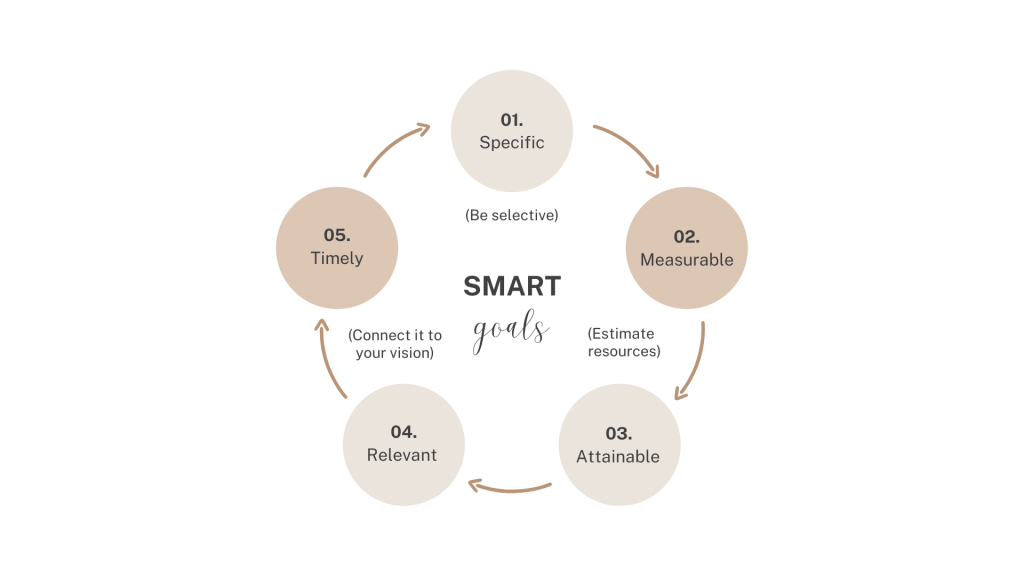
How to utilize SMART goals
While SMART goals are a great way to map out ideas for a more productive planning process, it’s important to distinguish goals from aspirations.
“The main difference between aspirations and goals are that aspirations are the dreamy, whispers in our minds of what we would like, and goals are the concrete path we take to realize those dreams.”
Deeper Spirit. (2022). What Are My Personal Growth And Career Aspirations? Deeper Spirit. https://www.deeperspirit.com/spirituality/chakras/how-to-increase-chakra-levels/
In this sense, aspirations tend to be vaguer. “I want to feel young and full of life again.”
Goals, on the other hand, include the steps traced to reach that aspiration. “I am going to start incorporating more fruits and vegetables into my diet and start jogging 3 days a week so that I can lose 25 pounds by August 1st, and I will use the MyFitnessPal app to track my progress.”
Three key items to keep in mind while you’re drafting your SMART goals include being selective, estimating your resources wisely, and making sure your goal ultimately connects to your overarching vision.

With that in mind, we can draft our SMART goals for an effective and productive marketing campaign.
S – M – A – R – T
Specific
A goal should be specific in order to make sure that your time and resources are being utilized appropriately
Measurable
A goal should have specific criteria in place to measure the progress
Attainable
A goal should not be impossible to achieve
Relevant
A goal should be relevant to the organization’s purpose and overarching goals
Timely
A goal should have a clear timeline with a start date and a target date

So, what does a SMART goal look like?
An example of a SMART goal might look something like this:
“I’m going to complete a Rosetta Stone app French language course to be able to speak French 6 months from now while I am vacationing in France.”
Specific
“I want to learn how to speak French.”
Measurable
“I will complete a French language course using the Rosetta Stone app.”
Attainable
“I previously took a French language course in high school for one semester and did relatively well and still remember some words and phrases.”
Relevant
“I will be traveling to France for my vacation, so I’d like to learn French to be able to speak with locals while I am staying there.”
Timely
“I have purchased my flight tickets for France 6 months from now.”
In summary,
SMART goals help to organize your goals in order to help you successfully achieve them by making them specific, measurable, achievable, relevant, and timely.
Sources cited
(1) Deeper Spirit. (2022). What Are My Personal Growth And Career Aspirations? Deeper Spirit. https://www.deeperspirit.com/spirituality/chakras/how-to-increase-chakra-levels/
 Business Diaries